When the Pharmacy Shelf Is Empty and Your Family Is Counting on You — What's Actually in Your Medicine Cabinet?
For every household that watched the shelves go bare and swore "never again" — the complete, Amish-inspired home-apothecary reference you prepare once, keep forever, and never have to wonder about at 2 a.m.
You probably remember the exact moment.
Maybe it was March 2020, standing in a pharmacy aisle that looked like it had been swept clean by a broom. Maybe it was a winter ice storm that closed every road between you and the nearest urgent care. Or maybe it was just last Tuesday — a grandchild coughing at two in the morning, the children's aisle picked over, and you standing there with an empty bottle in your hand thinking, I used to know what to do for this.
That feeling — the tight knot in your stomach when "help" depends on a supply chain, a store that's open, a doctor who can see you sometime next week — doesn't go away. It shouldn't go away. Because the shelves did go empty. And nobody promised it won't happen again.
The people who sleep well at night aren't the ones who assume the system will hold. They're the ones who've already built the safety net — quietly, in their own kitchen, with things they grew or bought once and learned to use before the emergency. The Amish have done exactly that for three hundred years. Not because they predicted a pandemic. Because they never handed that responsibility to a shelf in the first place.
But here's what almost nobody tells you when you try to build that cabinet for yourself — and it's the reason most of the books, blogs, and "complete guides" out there will fail you the one night you actually need them.

The knowledge didn't just get old. It got lost.
A woman named Lydia Good once catalogued, in an online comment thread, the remedies her mother kept: catnip tea for fever. Oregano oil dropped on a toothache. A folk ointment for burns and wounds so well-known in Plain communities that a hospital burn unit at the University of Michigan actually allows families to bring it in. Bacon fat pressed to a scalp wound. "Have no idea what that was supposed to do," Lydia wrote. "But it worked."
Her mother never looked any of it up. She didn't need to — it was in her, passed hand to hand the way a language is passed, not from a textbook but from living in the same kitchen. And that's exactly why it disappeared. Because the moment the last person who carried it stopped being in the room, the chain broke.
This isn't just nostalgia. It's a practical emergency. Every year, the generation that kept those remedies alive gets smaller — and the generation that needs them gets more dependent on a system that charges $300 for a five-minute visit and sends you home with a side-effect sheet longer than the prescription.
"At 65, I still do not go to doctors," wrote one commenter. "Some home remedies may sound strange but they work." Another: "There is almost always something that works just as well as their drugs." These aren't fringe voices. They're the last echo of a way of life that most families let slip — not because it failed, but because nobody thought to write it down.
Here's the misunderstanding that keeps the loss going: most people think the problem is finding the recipes. It isn't. The recipes are everywhere — on blogs, in pamphlets, in a hundred interchangeable books with dried-herb covers. What was lost wasn't a list of ingredients. It was the method — the quiet logic your grandmother carried that told her which remedy, in what form, at what moment, and when to stop and call the doctor instead. A pile of recipes without that logic is like a bag of parts without an engine. It looks complete. It does nothing when you need it.
That's what The Amish Home Apothecary was built to return — not just the remedies, but the framework underneath them, in a single book substantial enough to sit on the kitchen shelf the way your grandmother's jar sat on the counter: always there, always ready, always trustworthy.
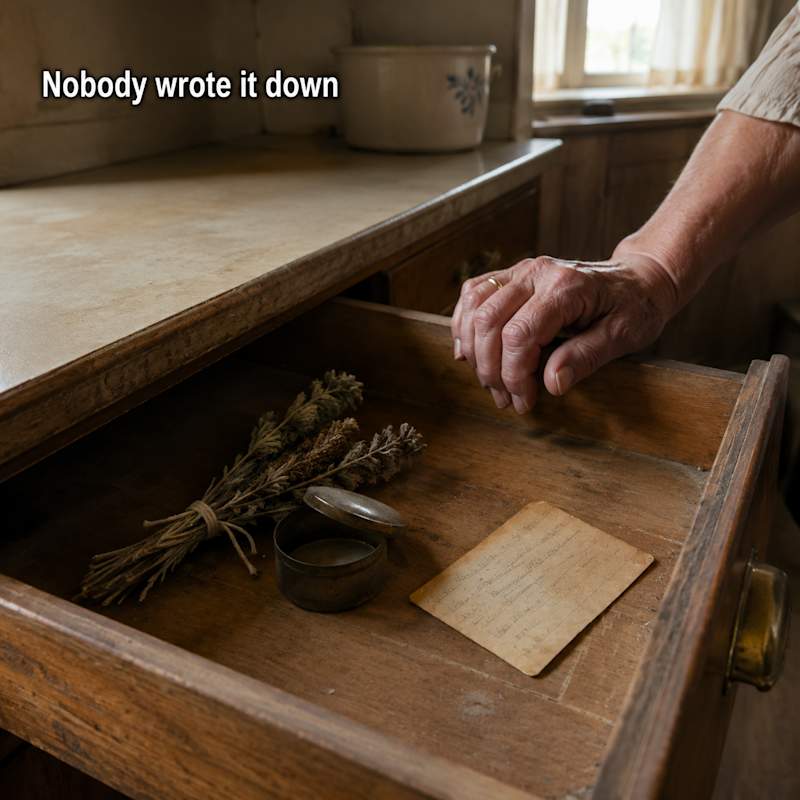
Everything you tried instead let you down (and it wasn't your fault).
If you've already gone looking for this kind of knowledge, you know the shelf. Sepia covers. Mortar-and-pestle photos. A Plain-sounding name. "Complete," "Ultimate," "Bible," "3000 Remedies." And inside — grey, blurry, photocopied images you couldn't identify a dandelion from.
"It looks like the pages were photocopied and there is no clear definition in the pictures, making them hard to identify," one reviewer of the best-selling herbal book in the category wrote. "A waste of money other than the words, which are still a bit blurry." Another: "More information can be found by doing simple Google searches. Just an expensive waste of money… I have returned it." A third: "I purchased the book and like the content overall, but agree that it is incomplete and lacking the zones where each medicinal plant grows."
Blurry photos. No sourcing information. No growth zones. Content you could have Googled. Thin enough to read on a lunch break and still feel cheated. That's what the $13 "Amish remedy" shelf delivers — and the free alternatives aren't better. "All the books and the blogs have the same advice while somehow also managing to say nothing past a starter kit shopping list," one herbalism writer observed. "You just realized each free newsletter is a hollow funnel into a paid course."
The pattern is the same whether you paid $13 or $0: a promise of completeness that dissolves the moment you actually need to use it. The cover says "everything you need." The inside says "good luck." And the worst part? After the second or third disappointment, you start to believe the knowledge just isn't available any more — that it died with your grandmother and nobody can get it back.
That belief is wrong. The knowledge exists. It's been practised, continuously, for centuries — in Plain communities, in rural households, in the hands of dedicated practitioners who never stopped making the teas, the salves, the tinctures. The problem was never that the knowledge was lost. The problem was that nobody with real hands-on experience had sat down, organised it into a usable system, and published it with enough honesty and substance to be worth the shelf space.
Until now.

A method, not a list: The Hearth & Herb Healing Method™.
This is where The Amish Home Apothecary breaks from everything else on the shelf — and it's the reason the book runs to 350 pages instead of the 112–128 you get from the cheap comparables.
Rebecca Fisher didn't compile a list. She built a system.
After years of studying and practising traditional, Amish-inspired home-apothecary methods — herbal teas, salves, poultices, syrups, tinctures, infused oils, natural first-aid preparations — she organised the entire body of knowledge into a framework she calls The Hearth & Herb Healing Method™. It rests on four steps:
Warm the Body — the starting place for everyday discomfort: the warming teas, the broths, the gentle preparations that comfort and settle before anything else is needed.
Draw Out and Soothe — the poultices, compresses, and topical applications the tradition uses for aches, skin irritations, and the minor bumps and scrapes of daily life.
Restore the Inner Fire — the tonics, syrups, and deeper preparations that support the body's own rhythms over days and weeks, not just in the moment.
Return to Rhythm — the maintenance practices: the pantry staples, the seasonal routines, the quiet daily habits that keep a household running without reaching for the medicine aisle every week.
Why does the method matter? Because a list of remedies — no matter how long — leaves you staring at the page asking which one? at the exact moment you need an answer. A method gives you the logic: start here, move here, and here is where you stop and call the doctor. It's the difference between owning a pile of ingredients and owning the knowledge your grandmother carried.
Most people believe the hard part of natural home remedies is memorising enough recipes. That's the misunderstanding the cheap books exploit — slap "3000 Remedies" on the cover and the buyer assumes more is better. But the real skill was never memorisation. It was judgment: knowing which remedy fits this moment, in this form, for this person. That judgment is what a method teaches and a list never can. And it's what makes 350 organised, method-driven pages more useful on a hard night than 3,000 entries you can't navigate.
Nobody else in the category has a named, structured method. It's not a small difference. It's the difference between a reference you use and a book you shelve after chapter two.

The safety net you build before you need it.
"You're at the mercy of the wind should shortage of supply become an issue."
That line was written by a herbalist reflecting on what lockdown revealed — and if you lived through the bare-shelf months, you already know exactly what it means. The supply chain is a convenience, not a guarantee. The pharmacy is open until it isn't. The doctor can see you — in eight to twelve days.
The Amish never built their family health practices around the assumption that the store would be stocked or the road would be clear. For three hundred years, "what's in the cabinet" meant what you grew, dried, prepared, and stored yourself. Not because they rejected the modern world as a matter of principle — but because, twenty miles from town and without a car, self-sufficiency wasn't a philosophy. It was Tuesday.
You don't have to live off-grid to understand the appeal. You just have to remember standing in that picked-over aisle, holding an empty bottle, and thinking: there has to be a better way to prepare for this.
Most people think building a home medicine cabinet means buying a lot of products. That's the wrong frame — and it's why the "preparedness" books that hand you a twenty-page shopping list don't actually prepare you. What the Amish approach teaches is not what to buy but what to make, how to store it, and when to use which preparation — the same method-driven logic from the four steps above, applied to the question of household readiness. A pantry stocked with dried herbs you don't know how to use is not a safety net. A pantry stocked with preparations you made, using a method you understand, is.
That's the reframe: the safety net isn't a product you buy once. It's a skill you learn once — and then the ingredients come from your garden, your kitchen, the same places they've always come from. The book includes a Backyard Medicinal Herb Garden Blueprint (one of five bonuses) and an Amish Pantry Staples Checklist specifically because the goal isn't to sell you an ongoing supply. It's to make you independent of one.
And here's the practical note that makes the timing matter: The Amish Home Apothecary is a physical book — a hardcover or paperback you keep on the shelf. Shipping takes roughly fifteen days. That's not a drawback. It's the point. You buy the safety net before the emergency, not during it. The household that orders this book today is the household that doesn't panic when the shelf goes empty next winter.
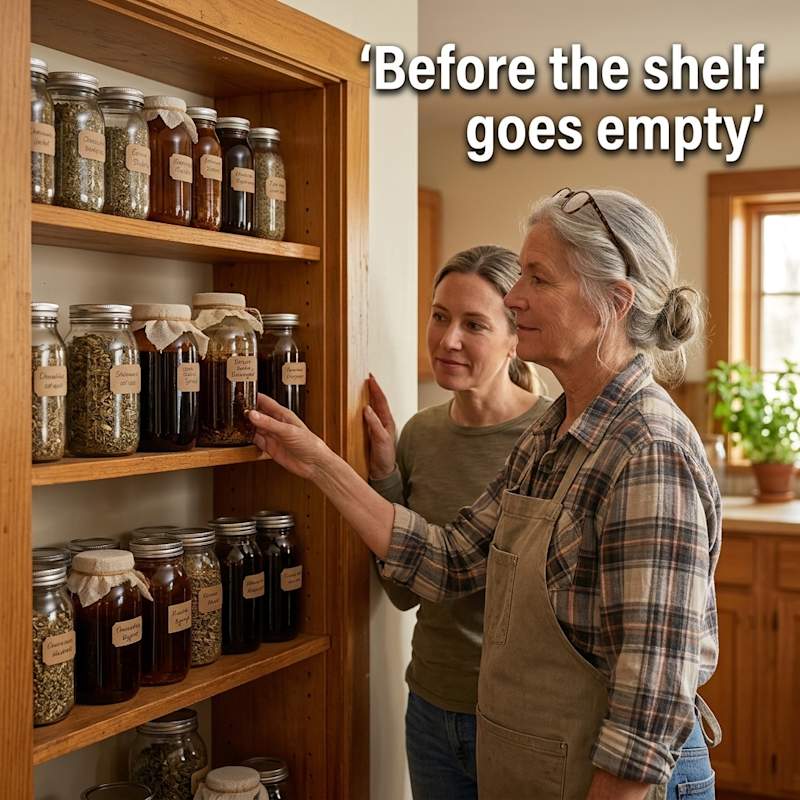
What you can see with your own eyes (and why that matters more than any promise).
Let's talk about something concrete — because in a category full of over-promising and under-delivering, concrete is what earns trust.
350 pages. Not a pamphlet, not a thin digital download, not 112 pages padded with stock photos. Three hundred and fifty pages of method-driven content in a physical book — paperback or hardcover — that sits on a shelf like a real reference should. In a genre where the cheap titles cluster around 112 to 128 pages, that's not a marketing number. It's a signal: this one was built to be complete, not fast.
Clear, usable plant photographs. This is the single most damning failure of the books that dominate this shelf. Reviewer after reviewer of the best-selling comparable writes the same complaint: "blurry," "photocopied," "hard to identify," "a waste of money." If you can't tell what the plant looks like — clearly, in colour, with enough detail to tell yarrow from Queen Anne's lace — the book is useless the moment it matters. The Amish Home Apothecary has clear, identifiable plant photos. That's not a boast. It's the bare minimum the other books failed to deliver, and the reason this one earns the shelf space.
A named method from a real practitioner. Rebecca Fisher is not a pen name pulled from a hat of Plain-sounding surnames. She's a home-apothecary practitioner and natural-wellness educator who spent years studying and systematising traditional, Amish-inspired methods into The Hearth & Herb Healing Method™. She is honest about what she is — a dedicated student and practitioner of the tradition, not someone born into a Plain community — and in a category flooded with fake identities and recycled content, that honesty is itself the proof. A list can be copied. A coherent, four-pillar method built from hands-on practice cannot.
Five bonuses included with every order:
- The Amish Herbal Remedies Quick Reference Guide — the "start here" card for the nights you need an answer fast.
- 50 Amish Comforting Tea Recipes — the simplest, most approachable entry into the tradition.
- The Backyard Medicinal Herb Garden Blueprint — because sourcing your own is the whole point.
- Amish Pantry Staples Checklist — what to keep on hand so the cabinet is never empty.
- The Audiobook — because not everyone learns best by reading, and a sixty-something pair of eyes deserves the option.
A 30-day money-back guarantee. If it doesn't meet the standard, send it back. No argument. The risk is on the book, not on you.
One note about price — because it matters. The cheap shelf runs $13 to $37. This book starts at $59.99 (paperback) and goes to $109.99 (hardcover + gift). That's a deliberate choice, not an accident. A $13 book gave you blurry photos, 112 recycled pages, and content you could have Googled. The Amish Home Apothecary gives you 350 pages, a named method, clear photos, a physical keepsake, and five bonuses. The premium is the product — and the $109.99 gift tier exists because this is the kind of book you buy once, keep for decades, and hand to your daughter. That's not a price. It's what a family reference is worth.
"Is this really Amish, or generic filler with an Amish cover?" That's the right question to ask — and here's the honest answer: this book is Amish-inspired, rooted in the traditional remedies and methods of Plain communities, and written by a practitioner who studied and systematised them. It does not pretend to be something it isn't. The method is real. The photos are clear. The content is substantial. And for anything serious — a burn that blisters, a fever that won't break, a child who can't breathe — the book will tell you plainly: call the doctor. That's not a weakness. That's the line between a reference you can trust and one that's trying to sell you a fantasy.

What Readers Are Saying
"This is the first remedy book I've owned where I can actually identify the plants from the photos. Clear, practical, and organized in a way that makes sense — not just a random list."
Dorothy M., rural Ohio
"I've bought three of these types of books before and returned two. This one stays on my kitchen shelf. The four-step method makes it easy to know where to start."
Karen L., western Pennsylvania
"Bought the hardcover for myself and the gift bundle for my daughter. It feels like a real reference — substantial, honest, and not trying to sell me a miracle. Exactly what I wanted."
Linda R., central Virginia
The kitchen shelf doesn't have to be empty.
Your grandmother carried a quiet, steady knowledge — what to reach for, how to prepare it, when to use it, and when to call for help instead. It didn't come from a search engine. It came from practice, passed hand to hand, generation to generation, in the same kitchen where she fed the family.
That chain broke for most of us. But the knowledge didn't disappear. It's been practised, refined, and now — for the first time — organised into a real, named method by a practitioner who spent years learning the traditional, Amish-inspired way.
Here's what's waiting on the other side of the page:
- 350 pages of method-driven, Amish-inspired home-apothecary knowledge — not a thin pamphlet, not a recycled list
- The Hearth & Herb Healing Method™ — four clear steps that tell you which remedy, when, and when to stop and call the doctor
- Clear, usable plant photographs you can actually identify — not the blurry, photocopied images the cheap books hand you
- Five bonuses included: the Quick Reference Guide, 50 comforting tea recipes, the Herb Garden Blueprint, the Pantry Staples Checklist, and the full audiobook
- A physical hardcover or paperback built to sit on the kitchen shelf for decades — the keepsake your grandmother would have wanted you to have
Every order is backed by a 30-day money-back guarantee. If the book doesn't meet the standard — if the photos aren't clear, if the method doesn't click, if it feels like another recycled disappointment — send it back. Full refund, no questions.
Shipping takes about 15 days. That's the nature of a real, physical book — and the reason to order it now, before the night you need it.
The shelf went empty once. Your kitchen doesn't have to.