Most Remedy Books Hand You a Pile of Cures. This One Hands You a Method.
For the woman who's bought the remedy book, tried the blog, and still doesn't trust what she's reading — here's what a real practitioner's system looks like, and why it changes everything.
You can tell, usually by page three, whether a remedy book was written by someone who actually does this.
Not someone who compiled a list from the internet. Not someone who slapped an Amish-sounding name on the cover and filled 112 pages with the same ten herbs every other book already listed. Someone who has actually stood over a pot of simmering calendula, strained it through cheesecloth, labeled the jar, and handed it to a person who needed it.
You can tell — because a real practitioner doesn't just say "calendula is good for skin." She tells you which preparation, in which order, for which kind of discomfort, and exactly when to stop and call the doctor instead. There's a logic to it. A through-line. A method.
And that's the thing almost every book in this category is missing. Not more remedies. Not a longer list. A method — a clear, honest system that turns a pile of plants and folk traditions into something you can actually trust, follow, and use. Which is why, when Rebecca Fisher published The Amish Home Apothecary and built it around a framework she'd developed over years of hands-on practice — a four-step system she calls The Hearth & Herb Healing Method™ — it felt, to a lot of readers, like the first time a remedy book had ever taken them seriously.
But the method is only part of the story. Because the reason most of us are even looking for a book like this — the reason we keep buying and returning, buying and returning — runs deeper than bad book quality. It's about something we lost, and haven't been able to get back.
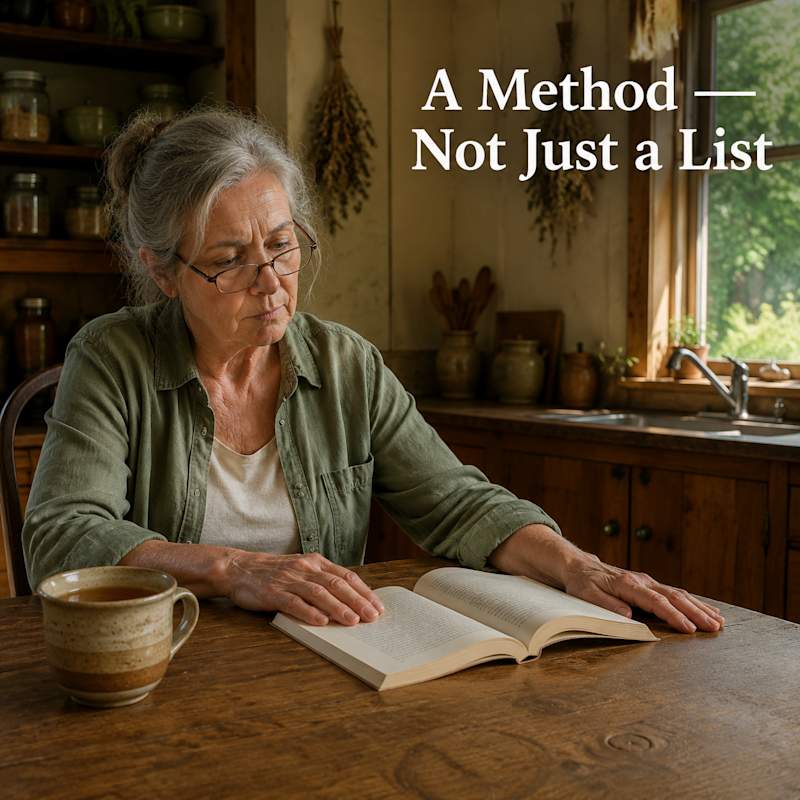
The Knowledge Didn't Disappear. It Was Never Written Down.

There's a particular kind of loss that doesn't announce itself.
Nobody calls to tell you that Grandma's cough syrup recipe died with her. No one marks the day your mother's poultice for bee stings passed out of living memory. It just… goes quiet. One day the jar is on the shelf; the next year, nobody remembers what was in it.
"I wish I had actually seen her do it," one woman wrote about her great-great-grandmother's remedy — something made from grapefruit seeds that cleared up mouth infections every time. She remembered the result. She just never got the recipe. Another woman — Lydia, a commenter on an Amish heritage site — could list her mother's entire kitchen pharmacy from memory: catnip tea for calming a fever, a drawing ointment for wounds, oregano oil dropped under the tongue at the first sign of a cold. She remembered every jar. She couldn't replicate a single one.
This is the real pain underneath the "natural remedies" trend — and it's the thing most remedy books refuse to acknowledge. It's not that people want to play doctor. It's that an entire generation of women who knew how to care for their families from the kitchen — simply, quietly, without drama — took that knowledge with them when they left. And what's on the shelf now, in its place, is a pharmacy full of things with side-effect labels longer than the instructions, and a pile of cheap remedy books that read like someone fed "herb list" into a search engine and hit print.
Here's what most people in this situation misunderstand: they think the gap is information. That if they could just find the right list of herbs and their uses, they'd have what Grandma had. But Grandma didn't have a list. She had a practice — a way of reading what the body needed and responding with what was in the kitchen, in a certain order, with a logic she'd learned from her own mother. The information was the smallest part of what she knew. The larger part was the method: when to warm, when to draw, when to nourish, when to rest. And that — the method — is what no list can give you.
That's exactly what The Amish Home Apothecary was built to be: not another remedy list, but a system for reclaiming that practice — organized, clear, honest — so the knowledge that went quiet can live again on your kitchen shelf. Written down, finally, in one place. In a book built to be kept — flagged, dog-eared, passed to your daughter.
Because at $59.99 for the paperback, or $79.99 for a hardcover you can hand down, or $109.99 for the hardcover-plus-gift package — this isn't a disposable pamphlet. It's 350 pages of the tradition you thought you'd lost. And it's built to last, because some things should.
When the Shelf Is Empty, You Need Something That Actually Works — Not a $13 PDF You Can't Even Read

Let's talk about what happened the last time you tried to solve this.
Maybe you bought one of the cheap remedy books — the ones with the Amish-sounding name on the cover, the $13 price tag, and the promises of "300 cures" inside. You opened it. And what you found was 112 pages of the same ten herbs listed in the same order as every other book on the shelf, with photos so blurry and dark you couldn't tell chamomile from ragweed. "It looks like the pages were photocopied," one buyer of the category's bestselling herbal book wrote. "There is no clear definition in the pictures making them hard to identify. A waste of money."
Or maybe you went the free route — the blogs, the newsletters, the "starter kits." And you found what one herbalist described perfectly: "All the books and blogs have the same advice while somehow also managing to say nothing past a starter kit shopping list." And then, at the bottom of the free article, the real purpose revealed itself: a funnel into a paid course. The information was the bait. The sale was the point.
Or maybe you tried the big, famous herbal reference — the 800-page one everyone recommends. And you found, as many buyers did, that it was "incomplete and lacking the zones where each medicinal plant grows" — it told you about the plant but not where to find it or how to actually prepare it. "More information can be found by doing simple Google searches," one frustrated buyer wrote. "I have returned it."
Here's the misunderstanding almost everyone makes after that experience: they conclude the category is the problem. That there's no such thing as a good remedy book. That the knowledge itself must be shallow if every book presenting it is shallow.
But that's not what's happening. The knowledge isn't shallow — it's deep, and it's real, and people like Lydia's mother lived inside it every day. What's shallow is the way it's been packaged: compiled by people who never practiced it, printed as cheaply as possible, sold on volume, and abandoned the moment the return window closes. The failure isn't the tradition. It's the books.
And that distinction matters enormously — because it means the problem is solvable. You don't need more information. You need a better source. A source that was written by someone who actually practices these preparations, who organized them into something you can follow, and who respected you enough to include clear photos you can actually use to identify the plant in your yard.
That's not hypothetical. The clear, usable plant photos in The Amish Home Apothecary were one of the first things people noticed — because in a category where "blurry" and "photocopied" are the most common complaints, being able to actually see the plant felt almost radical.
A Method, Not a List: The Hearth & Herb Healing Method™

This is the part that changes whether you trust a remedy book or just tolerate it.
Most books in this space hand you a list. Herb A is for symptom B. Herb C is for symptom D. Three hundred entries, alphabetical, and you're on your own. There's no through-line, no philosophy, no why. It's a dictionary, not a guide — and dictionaries don't teach you the language.
Rebecca Fisher built The Amish Home Apothecary differently. She's a home-apothecary practitioner and natural-wellness educator who spent years studying and systematizing the traditional, Amish-inspired way of home care — the teas, salves, poultices, syrups, tinctures, and infused oils that Plain communities never stopped using. She didn't just collect recipes. She identified the logic underneath them — the reason certain remedies are used in a certain order, the way a grandmother's kitchen pharmacy actually worked as a system, not a grab-bag.
She called it The Hearth & Herb Healing Method™, and it rests on four pillars:
Warm the Body. Draw Out and Soothe. Restore the Inner Fire. Return to Rhythm.
Those four steps aren't marketing language. They're the organizing structure of the entire book — 350 pages arranged around a progression that mirrors the way traditional home care actually unfolds. When someone in the house feels off, you don't reach for a random herb. You assess: does the body need warming? Soothing? Nourishing? Resting? And the method walks you through that decision — simply, clearly, in plain language — so that you're not guessing, you're following a system.
Here's why that matters more than any list ever could: the thing that makes people distrust remedy books isn't the remedies. It's the disorder. A list of 300 herbs with no organizing logic feels arbitrary — like someone pulled them from a search engine, which in many cases they did. But a method — a coherent, named framework with a clear progression — signals something different. It signals that the person who wrote this thought it through. That there's a mind behind the book, not just a content mill.
And in a category flooded with generic, Amish-sounding pen names on books that are "a waste of money other than the words, which are still a bit blurry," that signal is everything. A list can be faked. A method can't — not convincingly. The Hearth & Herb Healing Method™ has no competitor in this space. No other book in the Amish-remedy genre offers a named, structured system. They offer collections. Rebecca Fisher offers a practice.
One important note, because it's part of what makes her honest: Rebecca doesn't claim to be Amish. She's a dedicated practitioner who studied and systematized the traditional, Amish-inspired way — openly inspired by, not pretending to be. In a category full of suspiciously Plain-sounding pen names on suspiciously thin books, that honesty is itself a kind of proof. She's not borrowing a costume. She's sharing a practice she's spent years inside of, and she put her real name and a real method behind it.
When There's No Doctor, What's in Your Cabinet?

"At 65, I still do not go to doctors," one woman wrote simply. "Some home remedies may sound strange but they work."
She wasn't being reckless. She was describing a way of life that used to be normal — where the household had its own medicine cabinet, its own knowledge, its own first line of response for the everyday complaints that didn't need a waiting room. A cough. A scrape. A stomachache. A child's fever in the middle of the night. Things that any competent grandmother could have handled from the pantry — and did, for centuries.
That way of life didn't disappear because it stopped working. It disappeared because the infrastructure changed. Pharmacies got closer. Insurance got more common. And gradually, almost invisibly, families outsourced their most basic self-care to a system that charges $200 for a five-minute visit, prescribes something with a page of side effects, and sends you home feeling more anxious than when you arrived.
And then the shelf went empty.
"You're at the mercy of the wind should shortage of supply become an issue," one herbalist wrote during the lockdown shortages. And that sentence cut to the bone — because it named the vulnerability most of us had quietly been ignoring. We'd handed over our family's first line of care to a supply chain. And supply chains break.
Most people, when they feel this vulnerability, make a mistake: they think the answer is stockpiling. More OTC meds. More bottles. More of the same system, just pre-purchased. But that misses the point. Stockpiles run out. What doesn't run out is the knowledge of how to make a cough syrup from the honey and thyme already in your pantry, or a soothing compress from the herbs in your garden, or a simple tea for settling a nervous stomach — the things that "The Survival Library" is named for. Not a warehouse of products. A library of knowledge — the kind that, once you have it, never goes out of stock.
The Amish Home Apothecary includes Bonus 4: The Amish Pantry Staples Checklist — the specific, named items to keep on hand so your kitchen is always ready. And Bonus 3: The Backyard Medicinal Herb Garden Blueprint — the single resource that answers the number-one complaint about the entire remedy-book genre: "it doesn't tell me where the plant grows or how to source it." Because the point isn't to make you dependent on a health-food store's supply chain instead of a pharmacy's. The point is to make you independent — to grow what you need, know how to use it, and never stand in front of an empty shelf again wondering what to do.
And for the things that do require a doctor — because some things do, and any honest book says so — you'll know when to call. That's not a weakness in the system. That's the system working the way it should.
What the Amish Kept, and What We Threw Away

For over three hundred years, Plain communities have maintained their own home apothecaries. Not as a trend. Not as "wellness." As daily life.
They kept the salves. They kept the teas. They kept the syrups and tinctures and poultices. They kept the knowledge of which plant to reach for and when, passed from mother to daughter at the kitchen table — unbroken, uninterrupted, while the rest of the country was busy replacing it all with the pharmacy aisle.
There's a famous example: the B&W (Burn and Wound) ointment, a traditional folk preparation the Amish have used for generations. It's so well-regarded that some hospital burn units actually allow families to bring it in for use alongside conventional care. That's not a cure claim — serious burns go to the ER, full stop. But it's a living illustration of what traditional, time-tested remedies look like when they're real: specific, named, practiced, and respected even by institutions that have every reason to dismiss them.
The common misunderstanding about the Amish and health is the romantic one — that they've "figured out" some secret to perfect health, and if we copy them, we'll have it too. That's not true. The Amish get sick. They go to hospitals. They're human. But what they have figured out — and what most American families have not — is how to maintain a first line of simple, everyday home care that handles the small things calmly, from the kitchen, without panic and without a copay. The everyday cough. The seasonal cold. The scraped knee. The upset stomach. The things your grandmother handled without thinking, because she had the jars, the knowledge, and the quiet confidence that came from a tradition she trusted.
The Amish Home Apothecary isn't claiming to make you Amish. It's offering you the part of their tradition that never should have been lost — the practical, everyday, kitchen-table part — organized through The Hearth & Herb Healing Method™, written in plain language, illustrated with clear photos you can actually use, and built into a 350-page reference that belongs on your shelf the way your grandmother's remedy book belonged on hers.
And it comes with Bonus 2: 50 Amish Healing Tea Recipes — the traditional, comforting teas Plain families have enjoyed for generations. Plus Bonus 1: The Amish Herbal Remedies Quick Reference Guide, for the days when you don't want to flip through 350 pages — you want the answer now, in one glance. And Bonus 5: The Audiobook, for anyone who'd rather listen while they work in the garden or the kitchen — because not everyone learns from a printed page, and a good reference should meet you where you are.
What Readers Are Saying
"Finally a remedy book that's actually organized. The four-step method made the whole topic feel approachable instead of overwhelming. I use it every week."
Dorothy M. — Asheville, NC
"The photos alone are worth it — I can actually identify the plants in my yard now. Clear, practical, and no fluff. This is the reference I wanted for years."
Karen T. — Lancaster, PA
"I bought the hardcover to keep on my kitchen shelf and already ordered a second one for my daughter. It's the kind of book you hand down."
Linda S. — Tulsa, OK
The Knowledge Your Family Almost Lost — Written Down, Organized, and Waiting on Your Shelf.
Here's what it comes down to.
The tradition is real. The remedies are real. The women who carried this knowledge were real — and most of them never wrote it down, because they didn't think they had to. They assumed someone would be watching. Someone would learn. Someone would carry it forward.
And then, one day, nobody did.
The Amish Home Apothecary by Rebecca Fisher exists because that thread doesn't have to stay broken. Here's what's inside:
- 350 pages of traditional, Amish-inspired home remedies — organized by The Hearth & Herb Healing Method™ (Warm the Body · Draw Out and Soothe · Restore the Inner Fire · Return to Rhythm), so you have a system, not a scattershot list.
- Clear, usable plant photos — the specific thing the category's most popular book was criticized for lacking. You can actually identify the plant you're looking at.
- A real author with a real method — Rebecca Fisher is a practitioner who studied and systematized the traditional, Amish-inspired way. Not a pen name. Not a content mill. A person who does this.
- Five bonuses included: the Quick Reference Guide (fast answers), 50 traditional comfort tea recipes, the Backyard Herb Garden Blueprint (grow your own), the Amish Pantry Staples Checklist (always be ready), and the full audiobook.
- A physical keepsake — paperback or hardcover — built to sit on your kitchen shelf, get flagged with sticky notes, and eventually get passed to your daughter.
This is the book you buy once. The reference you keep. The tradition you reclaim — before the last thread breaks.
$59.99 paperback · $79.99 hardcover · $109.99 hardcover + gift.
30-day money-back guarantee. If you open it and it's not the honest, complete, usable reference it promises to be — send it back. That's the promise, and it's simple.
One last thing: shipping takes about 15 days, because this is a real, physical book — not a PDF download. Which means the right time to order is before you need it. The shelf is full today. Your kitchen is warm today. The tradition is still within reach — today.