Before You Buy Another Herbal Remedy Book, Read This Warning About What 90% of Them Leave Out
A mother of two spent 18 months buried in herbal guides, blogs, and supplement labels — and still couldn't tell what was safe, what actually worked, or where to start. Here's what she finally found that changed how she evaluates every natural remedy book on the shelf.


You know that moment. You're standing in your kitchen at 9 p.m., staring at a countertop that looks like a supplement store exploded. There's the turmeric capsules your coworker swore by. The elderberry syrup from a blog you bookmarked six months ago. A half-used bottle of St. John's wort that gave you terrible stomach cramps the one time you tried it. Three different "immune support" tinctures — none of which you can remember the dosage for.
And somewhere in the back of the cabinet, two herbal remedy books you bought last year. One reads like a college textbook. The other promised "miracle cures" on the cover and turned out to be 80 pages of vague folklore with no preparation instructions.

You've spent hundreds of dollars. You've "done all the things." And if someone asked you right now — "What's actually working?" — you'd have no honest answer.
That's not a personal failing. That's what happens when every natural-wellness resource you find is either too dense to use or too hyped to trust.
The frustration isn't just about money — though the money stings. It's about feeling less confident than when you started. You came to natural remedies because you were tired of the harsh stuff. Tired of scanning side-effect inserts. Tired of that quiet worry every time you gave your kid another dose of something you weren't sure about.
You wanted a gentler way.
Instead, you got a cluttered counter, a cluttered mind, and a growing suspicion that maybe "natural wellness" is just another industry happy to take your money without giving you clarity.
Here's the thing most herbal guides won't tell you: the overwhelm isn't your fault — it's a design failure. Most books in this space are written either for trained herbalists or for people who'll believe anything. Almost none are written for someone like you — a smart, cautious beginner who just wants to know what's safe, what works for everyday needs, and how to actually prepare it at home.
That gap is exactly what one particular book claims to fill. And the way to tell if it's real is simpler than you think.
The Warning Nobody Gives You Before You Buy a Herbal Remedy Book

Before you add one more book to your cart, here's what to watch for — because the natural-healing shelf has a pattern, and it's not in your favor.
Warning #1: No named method = no real structure. Most herbal books are organized alphabetically by plant or loosely by ailment. That means you have to figure out which herb matches your need, whether it's safe to combine, how to prepare it, and how to build a routine. The book gives you ingredients. You're left to be your own herbalist. For a beginner, that's not guidance — it's a research project.
Warning #2: "500 remedies" can mean 500 one-liners. Page count and remedy count matter, but only if each remedy comes with actual preparation instructions, safety notes, and context. Some books inflate the count with entries like "chamomile — calming" and call that a remedy. Before you buy, look for whether the book teaches you how to make the remedy, not just that it exists.
Warning #3: No safety framework = real risk. A responsible guide should tell you what to skip as clearly as it tells you what to try. If the book has no caution framework, it's not protecting you.
Warning #4: No "talk to your doctor" = a red flag. Any herbal book that positions itself against conventional medicine — rather than alongside it — is selling ideology, not wellness. The best natural-remedy guides are the ones that say, plainly, this is a complement, not a replacement.
'Natural' doesn't always mean safe, particularly if you are pregnant or nursing. Natural remedies and supplements aren't regulated.— Experienced home herbalist, wellness community
These four warnings aren't meant to scare you away from herbal books. They're meant to give you a filter — so you can tell the trustworthy ones from the hype.
The 4-Step Test That Changes How You Evaluate Any Herbal Guide

Here's something most people never calculate before buying a natural-remedy book.
Think about what you've spent in the last 12 months on individual supplements, tinctures, loose herbs, and wellness products you saw recommended online. For most households, that number lands somewhere between $200 and $500 — often more. And that's before the books, courses, and consultations.
Now ask yourself: how much of that spending was guided by a single, clear method you trust?
For most people, the answer is none. Every purchase was a separate bet — a blog post here, a friend's recommendation there, an Instagram ad somewhere else. No system. No structure. No way to know what was actually contributing and what was just draining the budget.
That's not a wellness routine. That's a slot machine.
The most expensive herbal remedy isn't the one that costs the most — it's the one you take without knowing why. And the most valuable thing a remedy book can give you isn't a longer list of herbs. It's a method — a structured way to evaluate what your body actually needs, match it to the right simple remedy, learn to prepare it yourself, and build it into a calm daily routine instead of a chaotic supplement shuffle.
Based on typical annual household supplement spending patternsWhen you're evaluating books, look for that method. Look for the system, not just the catalog.
One book in particular makes this its entire architecture. And the method has a name. See how the Root-to-Ritual™ Method works →
What to Look for — and What One Book Actually Delivers

The book is called The Natural Healing Handbook by Jane Miller, and its core promise is a structured system called the Root-to-Ritual™ Method — four steps that take you from "something feels off" to a calm, repeatable daily wellness ritual.
That method is the spine of the book — and it's the first thing to verify when you're evaluating it.
Three Ways to Verify Before You Commit
Check the Method
Look for the Root-to-Ritual™ framework. If the four steps are clearly laid out and consistently used throughout, the structure is real.
Check the Safety Posture
Look for caution notes, contraindication flags, and explicit "discuss with your doctor" language. A trustworthy guide includes what to avoid.
Check the Preparation Detail
Pick any remedy at random. Does it include ingredients, quantities, method, and timing — or just a name and a claim?
What People Researching This Book Keep Coming Back To

When you look at what draws people to The Natural Healing Handbook during their research, a pattern emerges — and it's not hype.
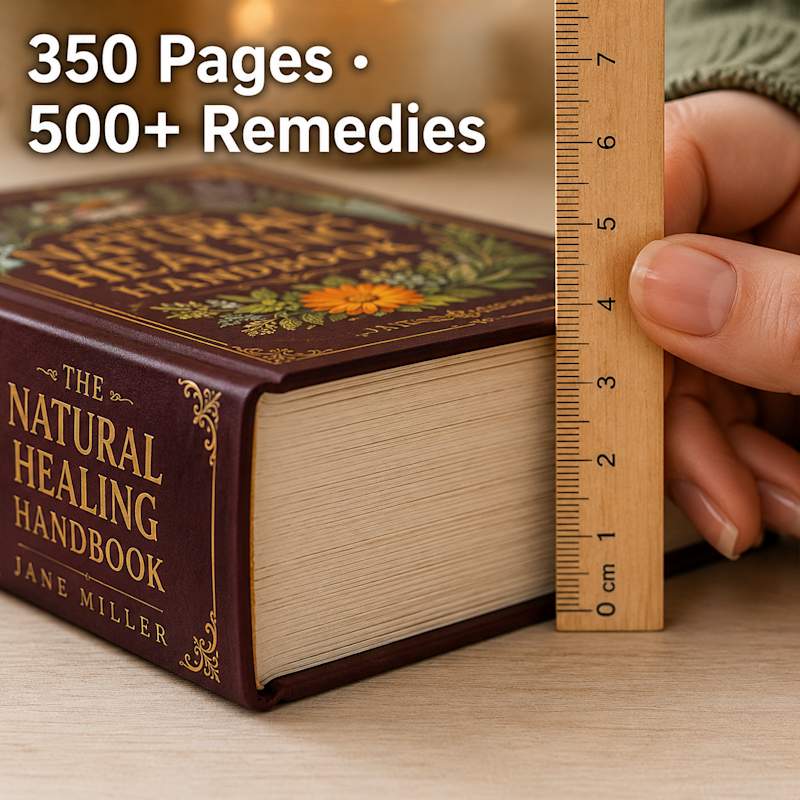
It's the scope. More than 500 herbal remedies — teas, tinctures, salves, and kitchen preparations — across 350 pages. That's not a pamphlet. That's a reference you'd keep on the counter for years. For people who've been burned by thin, padded guides, the sheer comprehensiveness is the first thing that earns a second look.
It's the author. Jane Miller is a home-apothecary educator who grew up in a household of chamomile, elderberry, calendula, and kitchen tinctures. She's studied traditional herbalism, folk remedies, and holistic wellness methods — and she's known for a warm, practical, beginner-friendly teaching style. She's not a doctor, and she doesn't pretend to be. She's the teacher who finally makes this world feel accessible instead of intimidating.
It's the extras. The book comes with four bonuses: a traditional herbal remedies collection, an herbal tea recipes guide, an emergency home apothecary checklist, and an audiobook edition. The bundle is designed so you're not buying one book — you're building a functional home apothecary library.
The remedies I can prepare myself have relieved my symptoms far better, with virtually no side effects.— Home herbalist, chronic wellness community
And there's a 30-day money-back guarantee — which means you can verify everything above after it arrives, risk-free. Check availability and choose your format →
But Is It Really Worth $59.99 for a Remedy Book?
Fair question. Here's how to think about it.
Add up what you've spent in the last six months on individual supplements, one-off tinctures, and random herbal products bought without a system. For most people researching books like this, that number is $200, $300, sometimes more — with no clear method guiding any of it.
The Natural Healing Handbook starts at $59.99 for the paperback. The hardcover is $79.99. The hardcover-plus-gift bundle is $109.99. Every tier includes the Root-to-Ritual™ Method, 500+ remedies, and the four bonus guides.
And if it doesn't meet the standard you now know to look for — a named method, preparation detail, a safety framework, and a beginner-friendly voice — you have 30 days to return it.
The question isn't whether $59.99 is a lot for a book. The question is whether it's less than what you'll spend without one clear, trustworthy system guiding your choices.
For most people doing the math, it is.